Showing posts with label 52 films in 52 weeks. Show all posts

Sunday, October 03, 2010

52 Films in 52 Weeks: Mr. Smith Goes to Washington


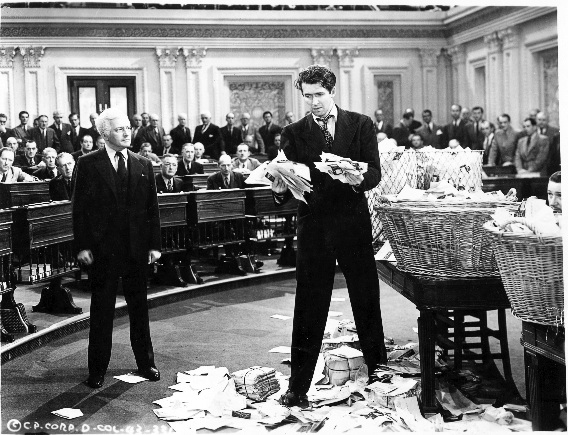
I'm doing terribly at this endeavor. With less than three months left in the year, I have only watched five of the 52 films on my list. Tonight I managed to cross Mr. Smith Goes to Washington off the list. This was a film I have always wanted to see--a deeply beloved classic. TCM aired it this weekend and I sat myself down to watch.

Mr. Smith Goes to Washington is exactly what I expected it to be, an entertaining and empowering piece of political schmaltz. Mr. Smith is too good to be true, and obviously someone as decent and innocent as he will never get elected in today's world. This is a film that would never work in today's very cynical days, but I think even the darkest cynic can not help but be moved to action by Mr. Smith's display of heroic filibustering in the film. If only there was at least one Mr. Smith in today's Congress. I think Mr. Smith Goes to Washington ought to be required annual viewing for members of Congress so that they can realign their priorities.

In technical terms, though, there's not much to discuss about Mr. Smith Goes to Washington. There's nothing groundbreaking about it. What its classic status rests on is its simple but heartwarming story and the power and appeal of the performances by Jimmy Stewart and Jean Arthur. Few people can pull of what Stewart does here, turning a rather dull, innocent of a character into someone appealing. Mr. Smith is almost too good, but Stewart makes us believe that such a person can exist and even be interesting. Stewart's performance takes off when he begins to discover that his fellow senators are not the well-meaning politicians he thought they were. The sense of betrayal and disappointment Stewart communicates through his eyes is heartbreaking.

My favorite performance, though, is Harry Carey's wry portrayal of the President of the Senate. With his bemused smile Carey creates a character who is pragmatic but not so broken that he fails to see the decency and strength of purpose displayed by Mr. Smith. The enjoyment he gets out of seeing the young senator filibuster and prove everyone wrong is one of the film's biggest delights.

Saturday, April 10, 2010

52 Films in 52 Weeks: Chinatown


From the beginning I doubted I would complete the "52 Films in 52 Weeks" challenge, but I'm still shocked how soon and how far I fell behind. "Chinatown" is only my third film and we're already 14 weeks into the year. I'm 11 weeks behind! I guess that's not insurmountable, but it would require me to double up movies some weeks. What makes it tough is that there are movies I also want to watch outside of this series. Currently I have Arnaud Desplechin's "A Christmas Tale" from Netflix. Netflix's streaming movies is proving to be an indispensable tool.

As I mentioned, my third film in this series is Roman Polanski's "Chinatown." I have long wanted to see this movie both for its classic status and--as I consider myself a Los Angeles booster--its depiction of the City of Angels. I'm happy to report that, like "Casablanca," it lives up to its reputation.

Jack Nicholson makes Jake Gittes a fascinating, well-rounded character. Gittes is jaded, cynical, manipulative, and tempermental, but he also proves to incredibly sympathetic and vulnerable. The look on Gittes's face at the film's conclusion as everything goes to heck is devastating. I guess this is the big surprise to me, how much depth there is to Gittes. I expected him to be a classic hard-boiled private investigator, but this was a nice surprise to find such a complex figure navigating us through the story.

The story itself is lurid but not in a sensational way. It seems to be a straightforward P.I. story at first--a woman hires Gittes to follow her husband who suspects of cheating on her--but then the layers are peeled and we are soon following a story that touches on political corruption, murder, and incest. Polanski grounds the film, though, so that as the story unfolds its dark, troubling secrets, the effect isn't something sensational or graphic. Instead the viewer feels the impact on these characters. It's lurid not for entertainment's sake but because life is full of dark, unseemly realities.

For its depiction of L.A., the filmmakers' experience in the city is clearly evident. From the neighborhoods and streets they mention specifically to the history of the city, Los Angeles is an essential component of the film. "Chinatown" does play to the L.A. stereotype of being an "artificial" city, a city that probably shouldn't exist let alone be the sprawling metropolis that it has become, but I think it also goes beyond that. "Chinatown" doesn't call into question Los Angeles's existence, but instead it brings to light the fact that underlying the city's growth and all the civic conveniences that have come about is a culture of corruption and greed. A price was paid for our comforts and as much as it can be smoothed over and hidden, it can't be undone. In this way it parallels the story of Faye Dunaway's character. Evelyn has lived a privileged life, but she paid for it in many ways. Like her, we are beholden to figures like her father, Noah Cross, for what they have provided us but we also are paying for their sins. There's nothing we can do about it now to correct it, so we are left to acknowledge the dirty truth and go on about with our lives.

"Chinatown" is a terrific film, and it ends with a perfect, albeit troubling line, a nihilistic shrug of sorts: "Forget it, Jake. It's Chinatown."

Monday, February 08, 2010

52 Films in 52 Weeks: You Can't Take It With You


Sadly, I've already fallen behind on my mission of watching 52 Oscar movies in 52 weeks. I'd say I'm about three weeks behind. I actually watched "You Can't Take It With You" a couple of weeks ago but never got around to posting my thoughts on it. In short, it's an entertaining movie that hasn't aged well--it was enjoyable and had very charming performances from the entire cast. What I enjoyed most was seeing Lionel Barrymore in essentially the polar opposite role he took on in "It's a Wonderful Life." Here he doesn't care about money, and in the later film that's all he cares about--and both films had the same message: no man is failure who has friends.

"You Can't Take It With You" is too slight and trifling, but worst of all, it drags and just didn't seem to want to end. It could have taken a more sprightly pace. However, if anyone's interested in remaking a best picture winner today, they should start with this one. I think it can be updated easily and effectively.

It makes me wonder how this year's Oscar nominees will fare years from now. Speaking of Oscars, I've somehow managed the feat of having seen all ten best picture nominees, practically all of them in theaters by paying real dollars! "The Blind Side" was the only one I saw via a borrowed screener. I've also seen a couple of others via screener. "The Lovely Bones" was a sad failure. I haven't read the book, but it seemed that Peter Jackson was too faithful and reverential. The "in-between" sequences were just too much, and by film's end I was rolling my eyes. Very disappointing.

Tonight I watched "A Single Man." I quite liked it, if a bit over-stylized. Still, its a very evocative and effective story of a gay man mourning the death of his longtime partner. This is an impressive debut from Tom Ford, focused and assured. The big surprise is how well he plumbs the depths of sadness and sorrow beyond just a shallow depiction. I guess it was a bit unfair of me to expect that Tom Ford would be unable to fashion something as substantial as this. It's a stylish and stylized film, yes, but it also has emotional heft beneath the film's gorgeous visuals. The film does wallow in its poetic depiction of sorrow a little too much. The film wears grief like a plush robe and never takes it off even for a moment. It could have used a change in emotional wardrobe now and then.

The performances are terrific. Colin Firth embodies grief and heartbreak beautifully and it's always a delight to see Julianne Moore. Nicholas Hoult is weirdly beguiling as an aggressively seductive student. He doesn't seem to be seducing Firth's character as much as he is pouncing on him, but Hoult and Firth have some nice moments near the end upon which the film's climax crucially depends. Matthew Goode was the one that impressed me the most. In the role of the dead lover, Goode has a character that in most films like it would essentially be hollow and beatific, but in his few scenes, Goode imbues the character with beauty and warmth. The film's best scenes involve Goode. First as he and Firth lounge at home reading, and second, the flashback to their meeting--the film's best moment. In these scenes we come to fathom the depth of George's grief. He has not only lost a lover but also the source of life's bliss and, to quote W.H. Auden, nothing now can ever come to any good. "A Single Man" really struck a chord, not just as a gay man. I think its story of loss and grief is universal and one that anyone can empathize.

I'm still doing a terrible job of updating this blog. Suffice it to say, I've actually run more than my posts the last few weeks suggest, but it's also true that I really ought to be running more. Due to a turn of events, though, I probably will have more time for both running and blogging now, and as I've been doing a lot of thinking lately it will probably be good for me to do both. We shall wait and see how well I do.

Sunday, January 03, 2010

52 Films in 52 Weeks: Casablanca


I frequent a pop culture discussion board and some of the participants have been doing a project called "52 Films in 52 Weeks" the last few years. The idea is to list 52 movies to watch during the year. Some list films they've been meaning to watch but never got around, some list films by decade or by year, some by director. I've never participated before, so this will be my first year. For my theme I am going with best picture winners I haven't seen or barely remember watching. That only took me to 45 movies, though, so I chose seven wild card movies, classic best picture nominees. I kicked off the series last night by watching Casablanca, which I owned. I picked it up at Virgin Records' clearance sale as it was about to shut down. I've had it for a year and just never got around to watching it.

With a lot of things--movies, books, albums--that have stellar reputations, approaching them can be a bit of a disappointment. Catcher in the Rye, for example, just couldn't match the breathless adoration people had for it. It probably didn't help that I read it after college, way past the ideal age for the novel to matter. Casablanca is an undisputed classic. As Roger Ebert says, no one has said one critical thing about it. It's a film even those who hate black and white movies fall in love with. Frankly, he's right.

Casablanca lives up to its reputation. The dialogue crackles, the performances are perfect, and the story captivates. It's unabashedly romantic but moreso because it's more complex, suggesting that love isn't just about getting the girl in the end, that sometimes letting her go is an even more truer expression of love. The film's love triangle between Humphrey Bogart's Rick, Ingrid Bergman's Ilsa, and Paul Henreid's Victor works because it is not uneven. Where most film love triangles are of the scalene variety, Casablanca's is refreshingly equilateral. Victor is a noble and worthy combatant for Ilsa's heart. The film tilts in favor of Rick and Ilsa on the passion meter, but it also wisely avoids painting Victor as unworthy of Ilsa's affection. If anything, we might wonder if Ilsa is worthy of Victor's love. Isn't it also interesting that the film seems to advocate for polyamory? The film does not judge Ilsa at all and justifies her love for two men at the same time. When was the last time you saw a movie that depicted polyamory as valid?

Watching Casablanca was a great way to kick off the series. I doubt, though, that they will all be as good. In fact I'm dreading quite a few of them. I've heard nothing good about Cecil B. DeMille's Greatest Show on Earth. One down, 51 more to go. Imagine, if all goes well, in a year I can say that I've seen almost all the best picture winners (I may miss some due to availability).